Child with bumper hat


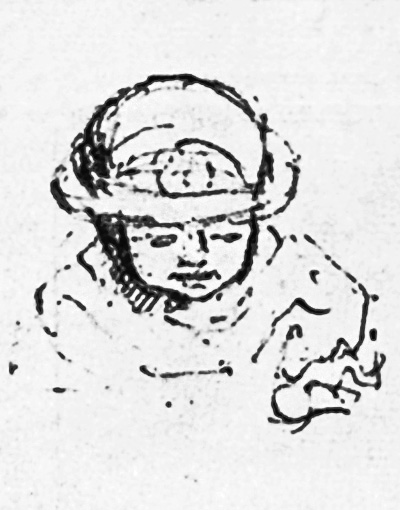
1st: Home; 2nd: by Lundens (1649); 3rd: sketch by Rembrandt (c.1642)
Besides the girls in blue08 and yellow09 at the center of the painting, Rembrandt includes a chubby toddler, probably a girl of about three years old, watching the scene from the outer edge.
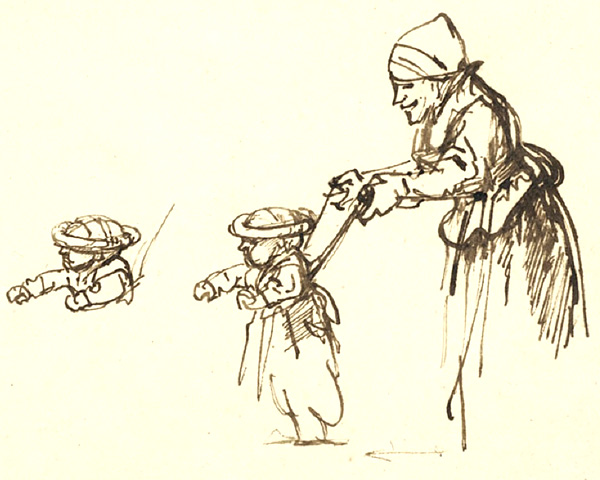
She struggles to pull herself high enough above the parapet of the bridge to see the spectacle of the marching militia. Could she be the owner of the ball, or apple38, that lies in front of van der Heede's07 left foot?
Around her head she wears a bumper hat, also known as a pudding cap, tied with cords. These padded caps were common for toddlers learning to walk, and Rembrandt made several sketches of such children between 1640 and 1649.
Musketeer Brugman31 may be shielding the burning wicks in his left hand with his hat to protect her. Unless Rembrandt relied solely on his own sketches, the child could be one of Brugman’s children: his son Joannes, born in 1638, or his daughter Margriet, born in 1640. De Roy's32 son Johannes, born in 1635, is a less convincing match. Rembrandt’s own early children died shortly after birth; only his son Titus (1641–1668) survived to adulthood.
Through this toddler, and through the two girls in the center, Rembrandt introduces the perspective of the spectator into the painting. They enliven a composition otherwise filled with armed civic guards. For a militia piece, the presence of a toddler and two young girls was entirely unique, and it adds a human warmth that subtly offsets the martial energy of the scene.