Jacob Dirckszn de Roy (1601 - 1659), scribe

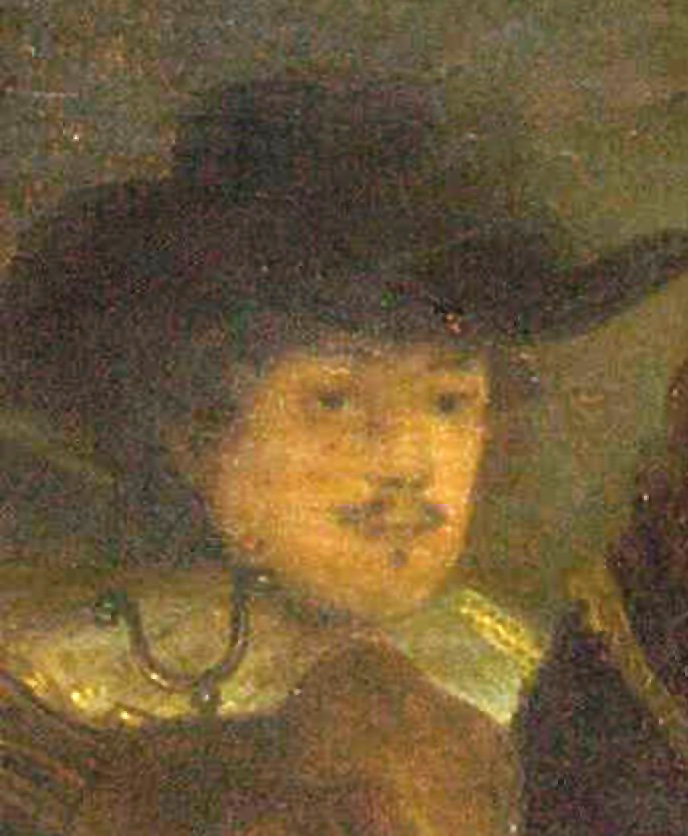
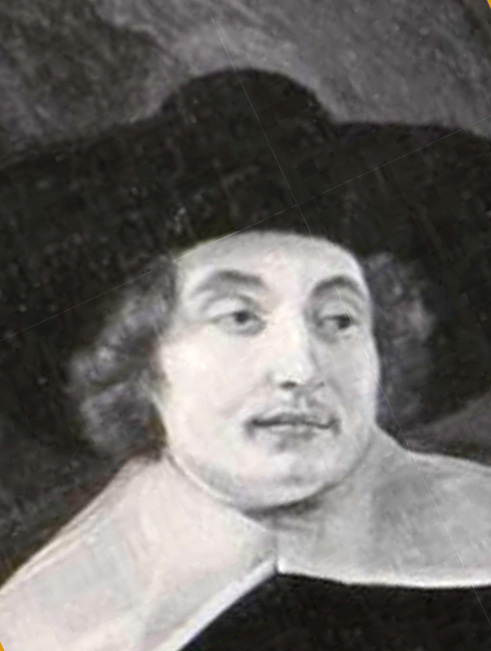
1st: Home; 2nd: by Lundens (1649); 3rd: by Bleeker (1641)
Jacob Dirckszn de Roy is the second guardsman who disappeared from The Night Watch when the painting was trimmed in 1715. After years of peat-fired fireplaces and tobacco smoke in the Kloveniersdoelen, the cartouche35 bearing the names of the guards had become invisable. De Roy’s position was sacrificed to preserve drummer Jorisz29 on the opposite side, even though Jorisz had not paid to be included.
For more than three centuries, de Roy enjoyed the mistaken luxury of being identified in the position of pikeman Bolhamer24. This changed in 2009, when historian Dudok van Heel published a new analysis that reassigned de Roy to the trimmed section. Given Bolhamer’s older appearance and the fact that de Roy was not known as a pikeman, the correction is convincing, though frustrating for his modern descendants.
In Gerrit Lundens’ copy of The Night Watch we see only de Roy’s face and hat; the rest of him is hidden behind Brugman's31 hat. So much for the hundred guilders he paid Rembrandt. De Roy does not wear a military uniform, which suggests he may have served as the company scribe, responsible for administration and oversight. This may explain why Rembrandt placed him next to provost Brugman, giving both men a vantage point over the group.
De Roy was a trader in cloth, fabrics, and furs. His parents died shortly after his birth in 1602 during a major plague epidemic. This bacterial disease struck Amsterdam repeatedly between 1600 and 1668, killing at least ten percent of the population each time. Rembrandt’s mistress Hendrickje Stoffels also died of the plague in 1663.
De Roy grew up with his mother’s Catholic family, where he learned the cloth trade. In 1626 he married Marritje Jansdr Bont, daughter of the wealthy cloth merchant Jan Gerritsz Bont. Although Catholics had been sidelined in Protestant Amsterdam since the iconoclasm, this rarely hindered business. In Amsterdam, trade always came before faith.
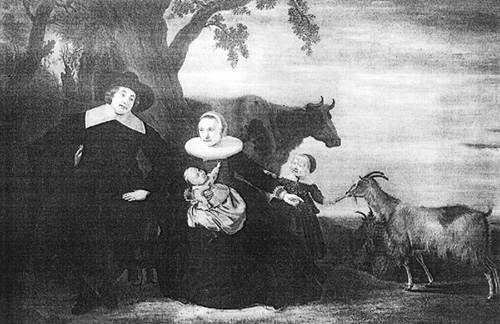
As a devout Catholic, de Roy and his father-in-law devoted themselves to caring for the poor.
In 1640 he became head of the cloth guild, likely the reason he commissioned painter Gerrit Bleker to make a portrait of him and his family.
Beyond trade and charity, de Roy was active in Amsterdam’s cultural life. In 1641 or 1642 he became director of the first municipal theater on the Keizersgracht, designed by Jacob van Campen.
The theater opened in January 1638 with the premiere of Joost van den Vondel’s Gijsbrecht van Aemstel. Because the play included a Catholic ceremony, the planned Christmas 1637 opening was postponed by a month. The play became a tradition, performed annually until 1968, and is still revived in modern forms today.
Rembrandt surely has seen this immensely popular drama about Amsterdam’s resilience. He may even have included a subtle reference to it in the collar plate of lieutenant Ruytenburch21.
Jacob de Roy thus emerges as far more than a trimmed-off face: a wealthy merchant, a Catholic philanthropist, a cultural figure, and a man whose brief appearance in The Night Watch hints at a life deeply woven into the fabric of 17th-century Amsterdam.