Cartouche with Civic Guard names
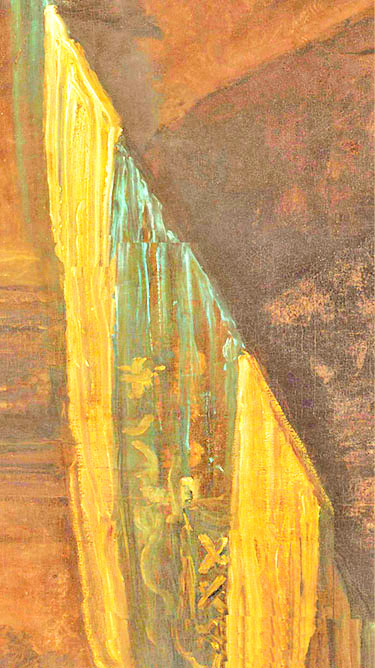
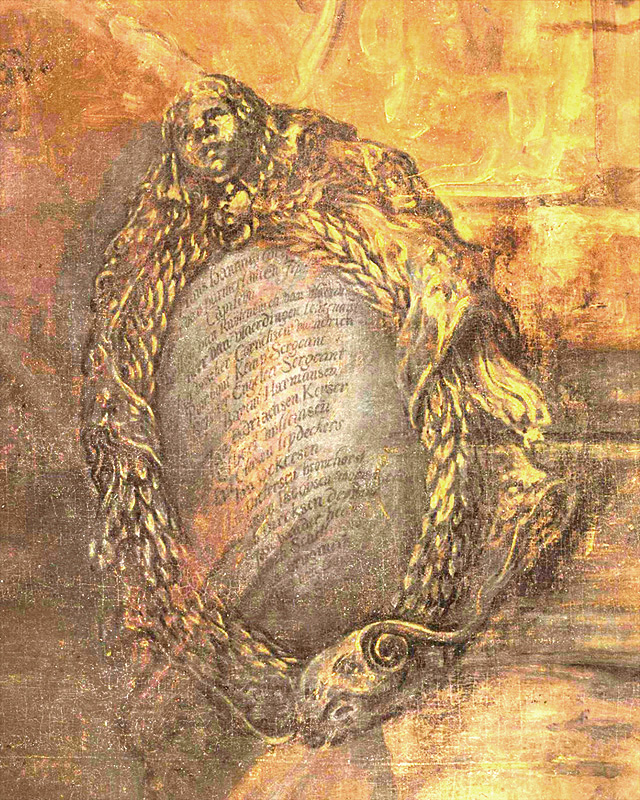
1st: Home; 2nd: Cartouche (click high-exposure image above to enlarge).
When Rembrandt completed The Night Watch in 1642, the painting contained no names. Not a single civic guard is identified on the canvas. This was not an oversight. Everyone at the Kloveniersdoelen knew perfectly well who these men were, and Rembrandt (not famous for his flexibility) likely had no interest in cluttering his composition with a list of sponsors.
Other militia painters, such as Govert Flinck and Bartholomeus van der Helst, were far more accommodating. Their works often included a separate plaque, or the names were carved into the frame. Rembrandt, however, produced his first and only militia painting, and he kept it clean.
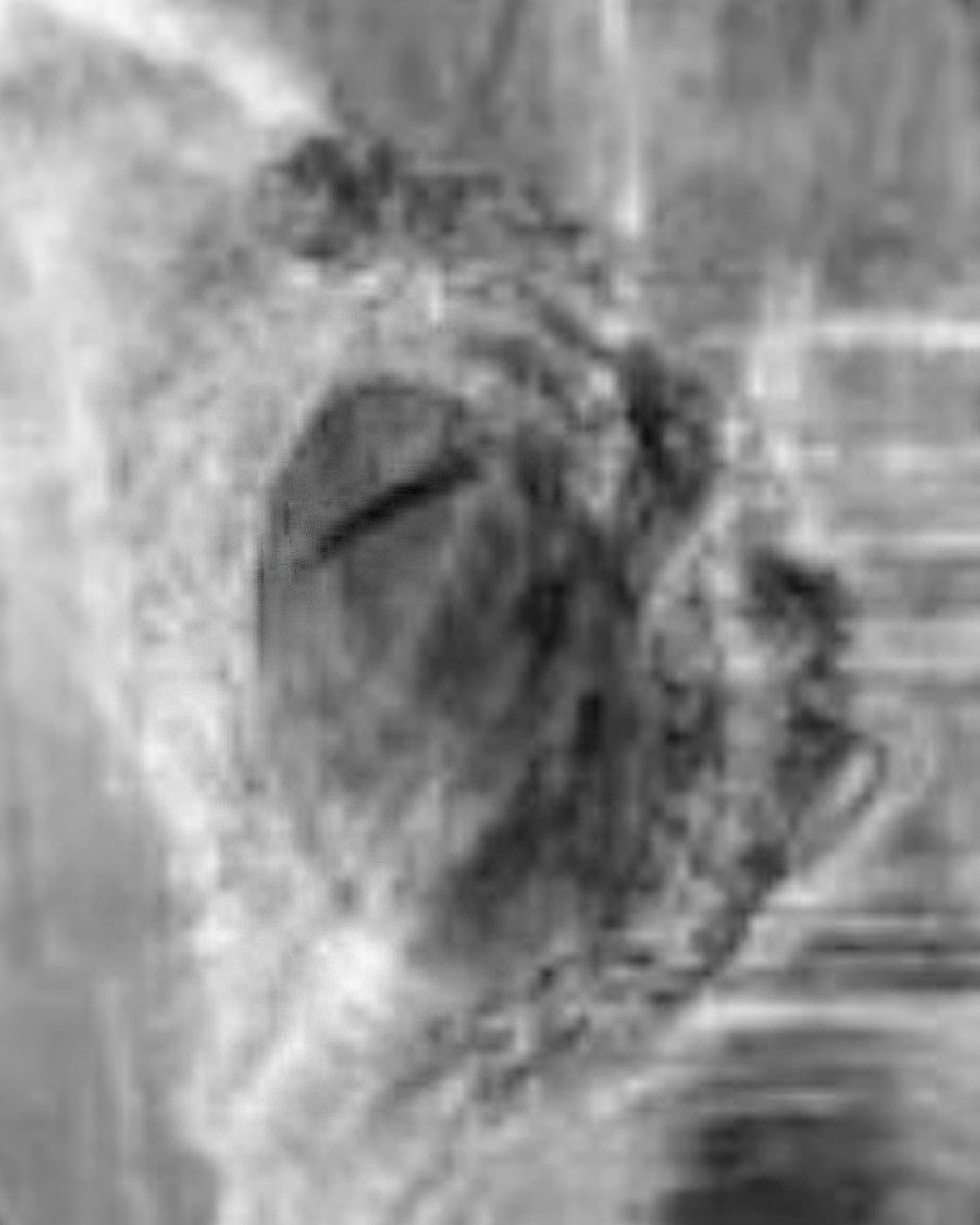
But a few years later, someone changed that. A decorative cartouche with the names of the paying militia members was added to the right side of the painted arch. A calcium scan of the painting shows Rembrandt’s original sketch of the pillar and wall beneath it; clear evidence that the cartouche was a later addition, not part of his plan.
For a long time, historians assumed the cartouche was added decades later, perhaps in the late 1650s when Rembrandt’s financial troubles made ownership documentation more urgent. Another theory placed the addition around 1715, when the painting was moved to the new city hall. But the more we learn, the earlier the cartouche seems to appear.
Given the ongoing deterioration of Rembrandt's work from the day it arrived at the Kloveniersdoelen, the task of removing varnish and added a cartouche would become more complex over time, and more recognizeable today.
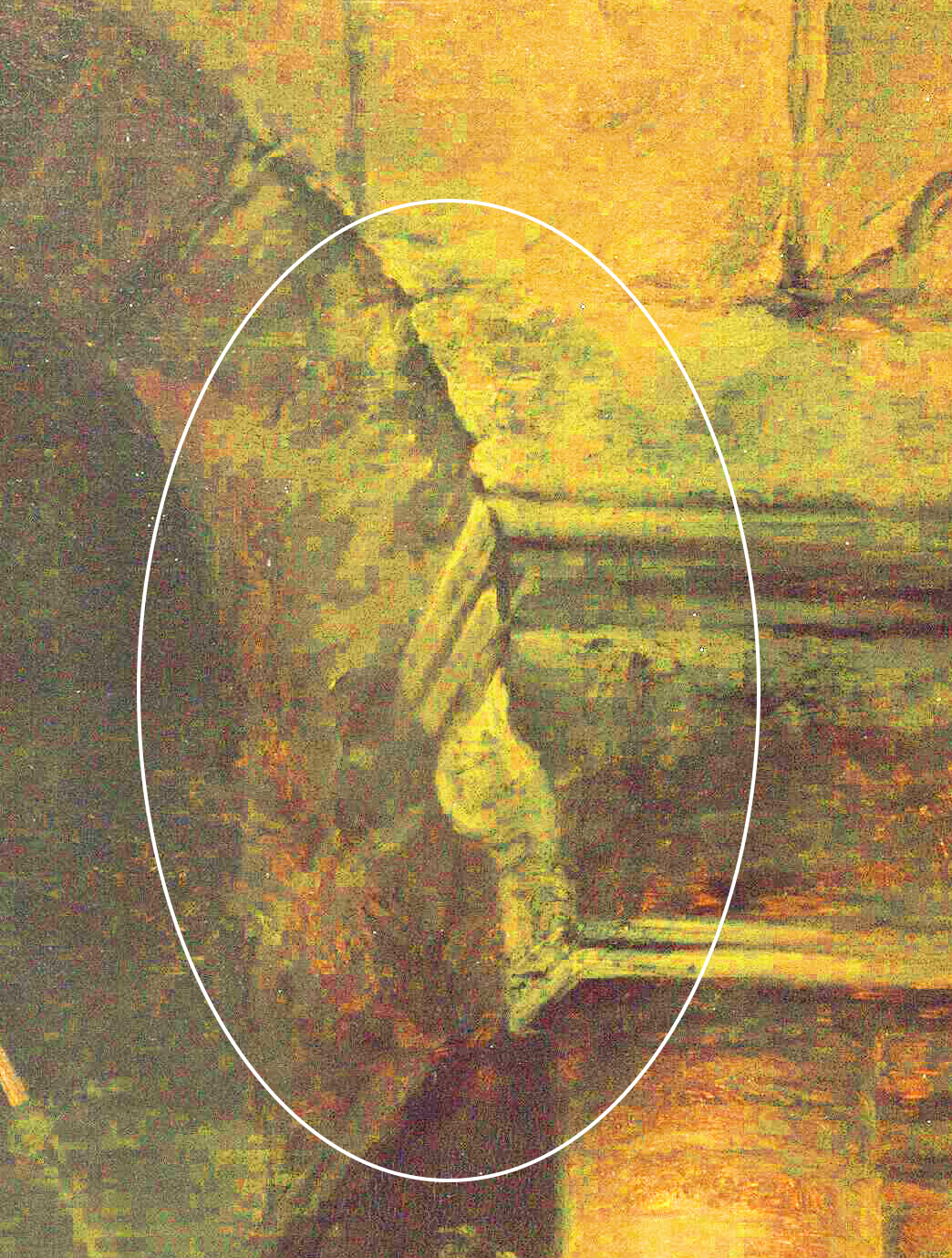
Gerrit Lundens’ small copy of The Night Watch — the one that saved the composition after the 1715 trimming — contains a crucial clue. Under close inspection, one sees a darker patch where Lundens originally painted the cartouche but later painted over it.
This means the cartouche already existed when he made his copy.
Lundens’ copy was almost certainly commissioned by Captain Frans Banninck Cocq16, either to celebrate his promotion to colonel in 1647 or to mark his departure from the militia when he became mayor in 1650. The latest possible date is Banninck Cocq’s death in 1655.
But stylistic comparisons made by art historian Gustav Glück in 1907 strongly suggest 1649 as the most plausible year.
If Lundens saw the cartouche in 1649, then it must have been added sometime between 1642 and 1649, much earlier than previously assumed.
The names on the cartouche correspond to the ranks as they existed under Banninck Cocq’s leadership (1638–1646), before Ruytenburch21 took over as captain. This change of command may have motivated someone to immortalize the names of District II’s proud militia members before the hierarchy shifted.
Why did Lundens remove the cartouche in his copy?
Several explanations are possible:
- Lundens respected Rembrandt’s original.
He may have realized that Rembrandt never intended the cartouche and chose to omit it out of loyalty to his former teacher. - Practicality. His canvas was small; fitting a list of names into a tiny decorative frame would have required a magnifying glass and superhuman patience.
- Client preference. Banninck Cocq may have wanted a copy of the painting as it originally appeared — without later additions.
Whatever the reason, Lundens’ decision to paint over the cartouche is one of the reasons we can now reconstruct its timeline.
The cartouche itself
The cartouche is a classic example of Dutch Baroque Auricular style: a cherub’s face at the top, a scroll-like mask at the bottom, and a laurel wreath wrapped in cloth-like forms on the sides.
It is decorative, theatrical, and slightly over the top; exactly what you would expect from a group of wealthy men eager to see their names displayed.
Given the size of the painting, the cartouche must have been added on-site at the Kloveniersdoelen. This was not a simple task. Someone had to climb a tall ladder, remove varnish, paint the ornamental frame, let it dry, and then carefully add the names — all while balancing at a height of three meters in a dimly lit hall illuminated by oil lamps. It was a recipe for spelling mistakes, cramped lettering, and mild existential regret.
The Van Vlaerdingen correction
A calcium scan reveals a black rectangular patch beneath the name “heer Van Vlaerdingen,” (here underlined in blue) suggesting that an error was corrected.
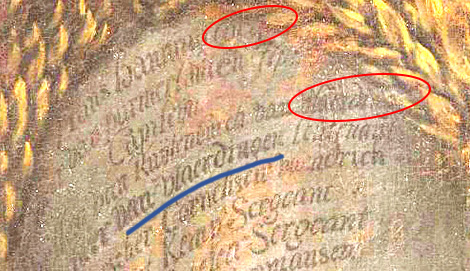
Two other areas (encircled in red) show how the final letters of “Banninck Cocq” and “Van Vlaerdingen” spill over the ornamental border.
This strongly suggests that the decorative frame was painted first, leaving an empty center, and the names were squeezed in afterward by someone who misjudged the available space.
In short: the cartouche was added by a decorator with ambition, and the names were added by someone with a ladder and a headache.
Who ordered the cartouche?
Most likely candidates are Captain Banninck Cocq and/or Lieutenant Ruytenburg (who became captain in 1646), but other wealthy guardsmen such as multimillionnaire Cruijsbergen15 had the means and motivation to preserve their names for posterity at the Kloveniersdoelen.
The civic guards owned the painting. They had paid for it. In the 17th century, ownership meant absolute control. The concept of “moral rights” for artists did not exist until the Berne Convention of 1886. If the guards wanted a cartouche, they were legally and socially free to add one.
Who painted it?
Rembrandt may have advised against it (he was not known for his enthusiasm toward client interference) but there is no evidence he refused. Faced with persistent demands from powerful men, he may have reluctantly agreed or delegated the task.
A plausible candidate is Gerbrand van den Eeckhout (1621 - 1674), Rembrandt’s former pupil, Leijdecker's23 nephew, and the son of a silversmith. He studied with Rembrandt around 1640, when work on The Night Watch was underway, and later became known for his decorative designs. The Auricular style of the cartouche fits his skill set.
The disappearing names
By the early 18th century, the names were barely visible due to darkened varnish and accumulated grime.
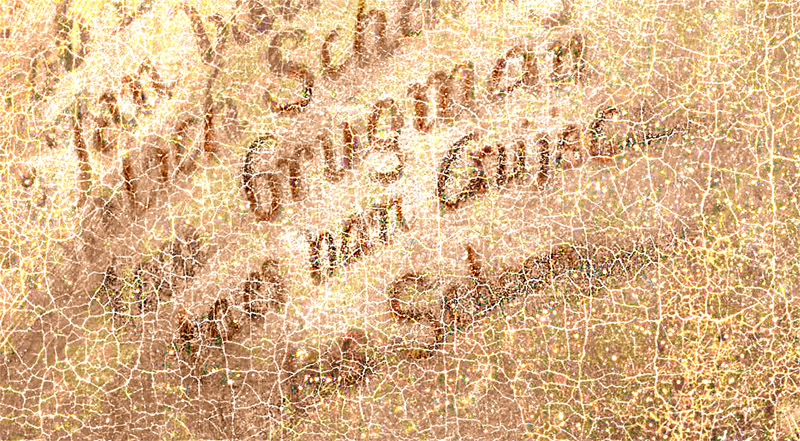
When the painting was moved to the new city hall in 1715, even the district of the guards was uncertain.
Later restorations revealed the first sixteen names with difficulty. The last two: Claes van Cruijsbergen15 and Paulus Schoonhoven30, only became legible after the 1947 restoration.
Even today, in the enhanced gigapixel image, Schoonhoven’s name remains a challenge. The cartouche has not aged gracefully.