Paulus Harmensz Schoonhoven (1595 - 1679), pikeman
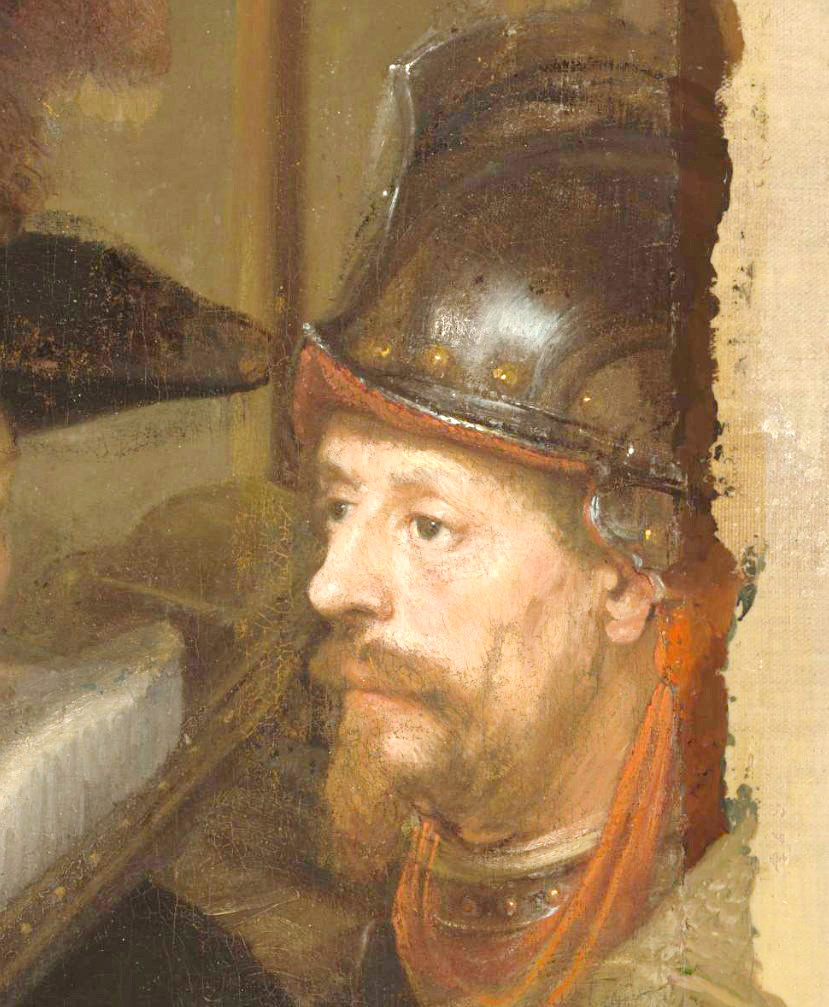
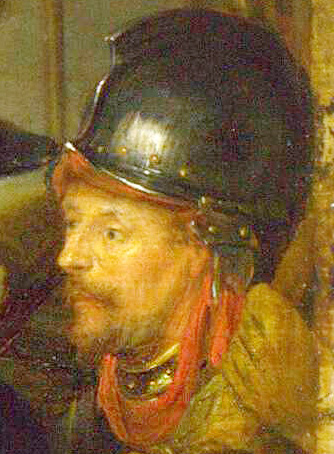
1st: Home; 2nd: by Rembrandt (1642); 3rd: by Lundens (1649).
Pikeman Schoonhoven appears last on the inscription in the cartouche35 and therefore held the lowest rank among the named guards. In the painting he receives his marching orders from Sergeant Kemp27 beside him. For a long time, because the surface of The Night Watch had darkened so heavily, only the letters Sch were visible. It was assumed to be an addition of Schrijver (scribe) to the name Cruijsbergen15 above it. Only after the major restoration of 1947 did the eighteenth name become readable again.
Schoonhoven came from the city of Goes (Zeeland) to Amsterdam in 1616, and learned the trade of stockbroker from his uncle, Isaac Florianus. The Amsterdam stock exchange was launched in 1602 as the first in the world.
Schoonhoven likely earned well during the infamous tulip boom of 1634 to 1637, for in 1639 he bought a house near the Singel in district 2 of the Kloveniers company and joined the militia led by Captain Banninck Cocq16.
Fortune was with him: by this move he was immortalized in The Night Watch, even if Rembrandt painted little more than his face and helmet for the hundred guilders he paid.
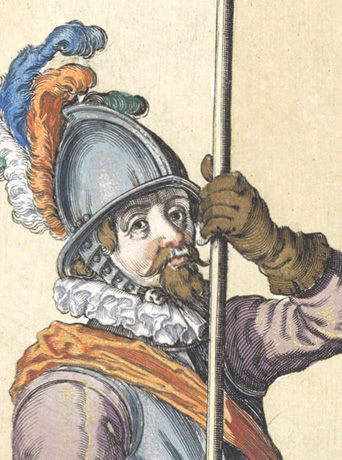
His helmet is a plain 17th century Spanish morion, also known as a pikeman’s pot. More luxurious versions had cheek flaps and a plume to indicate status. Schoonhoven does have cheek flaps, painted in the more expensive red that suggests wealth, but he lacks a plume.
According to de Gheyn’s 1607 weapons manual, used by Rembrandt as source several civic guards in the painting, these helmets have a ridge at the front to protect the forehead and a fin at the back where a plume could be attached.
In The Night Watch, Schoonhoven’s helmet appears to be either placed backwards, or is an unusual model.
When the painting was trimmed in 1715 to fit between two doors in the new town hall, the little that Rembrandt included of Schoonhoven was cut as well. He lost part of his head and back. Only through Lundens’ copy did it become clear that Schoonhoven was a pikeman; in the copy he holds his pike in a gloved hand, in line with de Gheyn's manual.
Schoonhoven married Hillegont Coenen in 1623, the same year he joined the stock exchange. They had ten children, a common number at the time. It was equally common for several children to die young; high child mortality kept the average life expectancy below fifty.
Yet those who survived childhood could reach old age, and Schoonhoven was one of them.
He traded for nearly half a century, from 1646 onward together with his eldest son Harman. He died at the age of 84 and was buried in the Nieuwe Kerk.
Rembrandt gives him only a small role in the painting, but his long life and successful career show that even the lower-ranked names on the shield belonged to men of substance in Amsterdam’s civic world.