Frans Banninck Cocq (1605 - 1655), captain
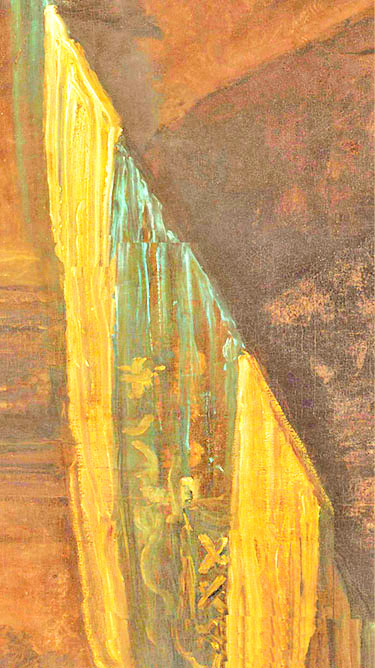
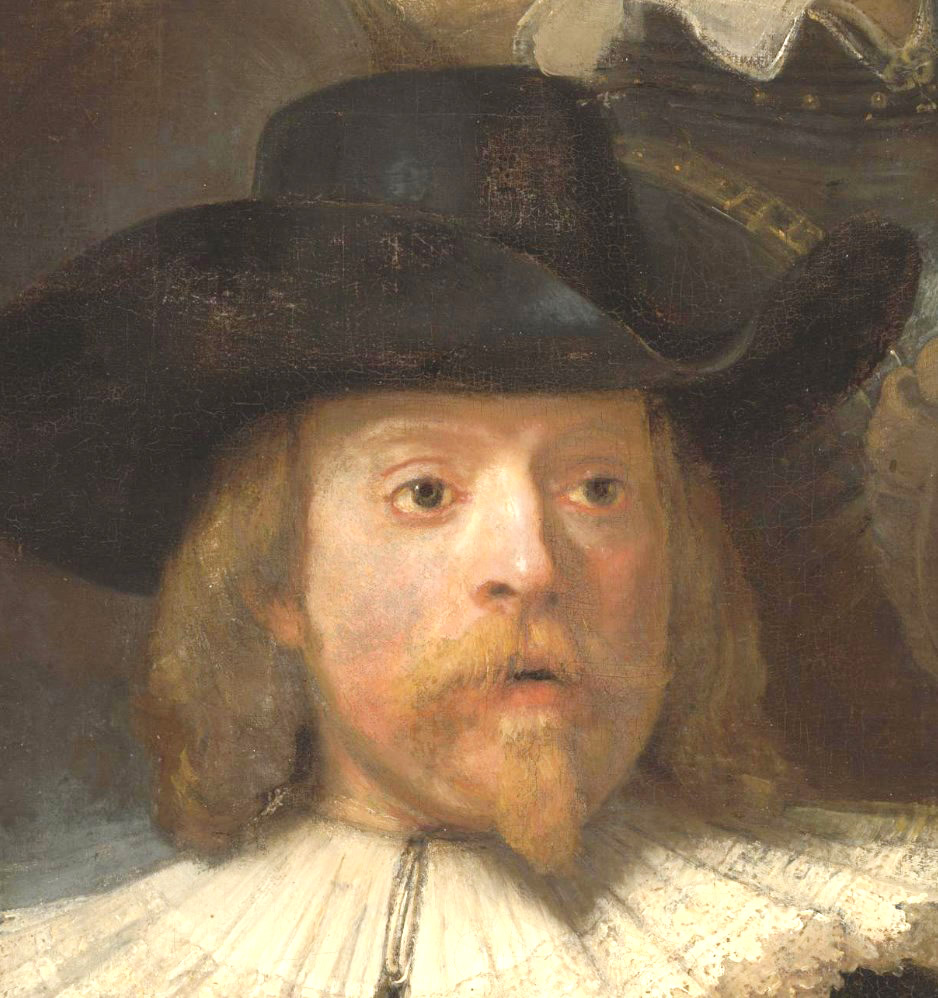
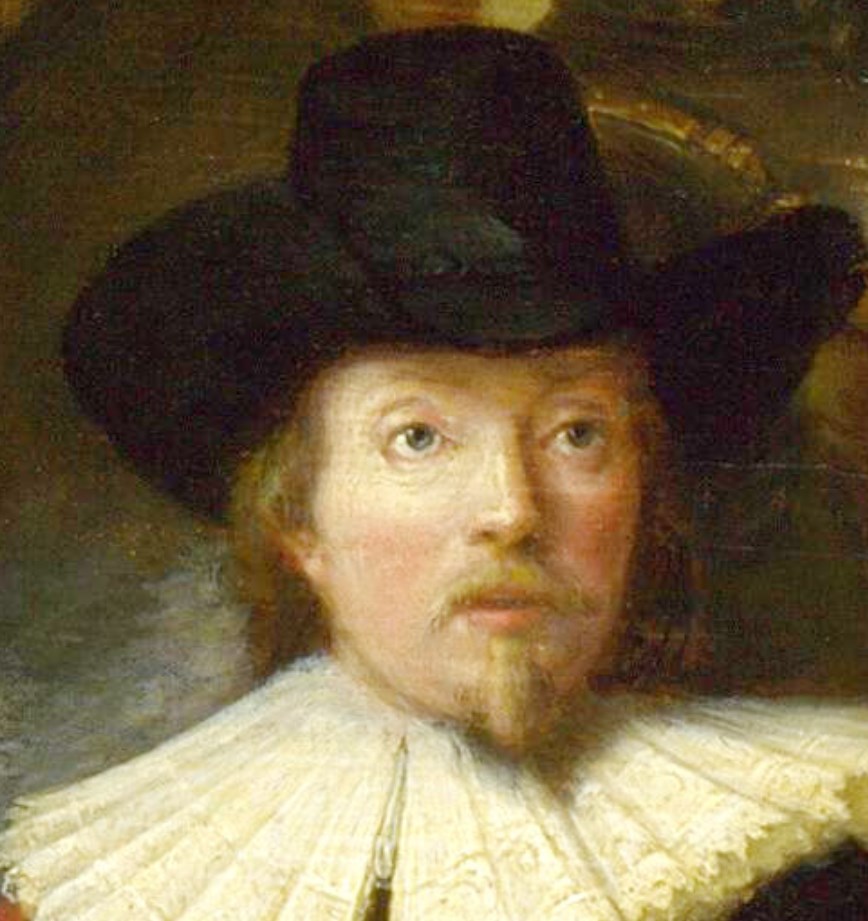
1st: Home; 2nd: by Rembrandt (1642); 3rd: by Lundens (1649).
Frans Banninck Cocq's position as captain of the 2nd district of the Kloveniers guild is visible through the wooden cane in his right hand. He is dressed less like a soldier and more like a magistrate, which is fitting: in 1650 he would become mayor of Amsterdam.
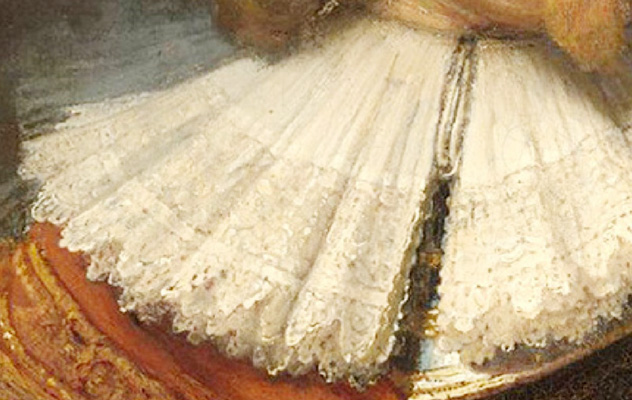
He does retain a few military signs. Beneath his white embroidered ruff, the blue shine of a metal collar plate is still visible, similar to the one worn by his lieutenant Ruytenburch21. He also carries a light sword on his left side.
Above his right shoulder, one can see that Rembrandt originally painted a wider ruff collar. It was later reduced, likely because Rembrandt decided to add the smoke rising from the firing musketeer14. The earlier ruff pattern reappeared over time as the paint aged.
Rembrandt shows Banninck Cocq speaking to Ruytenburch, his mouth slightly open to give him an active role. He extends his ungloved left hand to give the order to march.
At the same time, the lively, fluttering ends of his sash show that he is already moving forward. They also allow Rembrandt to reveal a more colorful, aristocratic side of the captain.
Banninck Cocq was the son of a wealthy pharmacist from Bremen and studied law in Poitiers. In 1630 he married Maria Overlander van Purmerland, daughter of the Amsterdam mayor Volker Overlander, who was also well off. They lived at Singel 140 in the house known as The Dolphin.
In the year of his marriage, his father-in-law died, making Banninck Cocq Lord of Purmerend and Ilpendam.
For a Dutch regent, this was as close to nobility as one could reasonably hope to get.
He first served as lieutenant of the civic guards in the 1st district and was likely promoted to captain of the 2nd district in late 1638. This district was the southeastern area of the old city center of Amsterdam, centered around the Kloveniersdoelen, the Nieuwmarkt, and the Sint Antoniesgate (the Waag).
In this role, he was responsible for accompanying Maria de Medici, exiled from France, during her triumphant visit to Amsterdam in the week of August 31, 1638. With every civic guard looking his best that week, it is easy to imagine that this inspired Banninck Cocq to commission Rembrandt to eternalise his civic guards group.
According to historian Dudok van Heel, Banninck Cocq and Ruytenburch paid far more than the usual 100 guilders to secure their prominent positions in the painting, likely at least 500 guilders each. Rembrandt may have earned around 2600 guilders for the commission, roughly ten times an annual salary at the time.
Since the early 16th century, hundreds of militia pieces had been painted. Painters Govert Flinck, Frans Hals, and Bartholomeus van der Helst received multiple commmissions. Rembrandt received (or accepted) only this single commission.
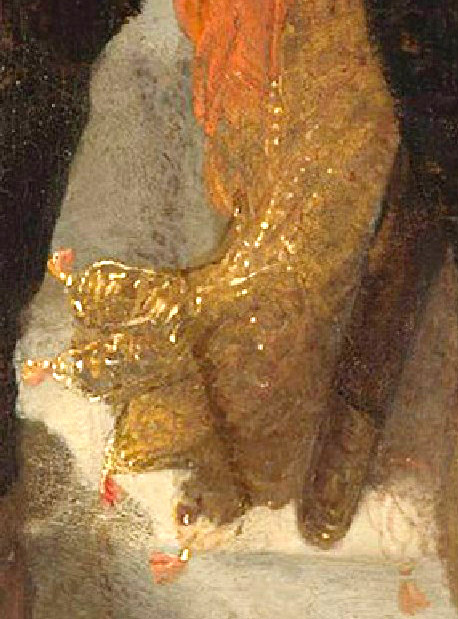
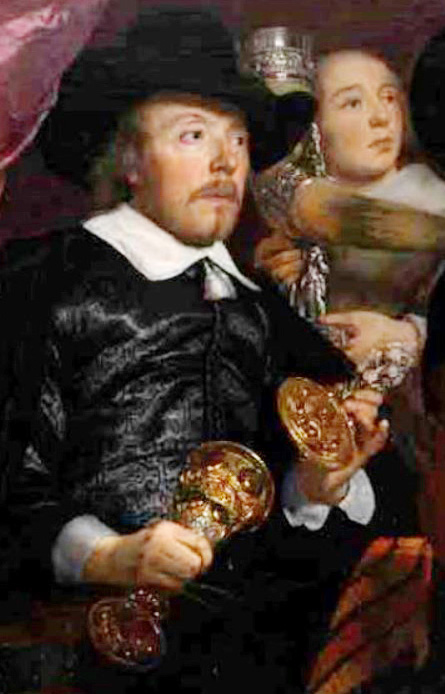
Banninck Cocq was pleased with Rembrandt's work: he had several personal copies made, likely including the copy by Gerrit Lundens. In 1653, he nevertheless preferred van der Helst for a painting of the four governors of the Longbow civic guard, in which he is depicted with a similar goblet (hanap) as carried by the girl in yellow09 dress on The Night Watch.