Jan Claesz Leijdeckers (1597 - 1640), musketeer
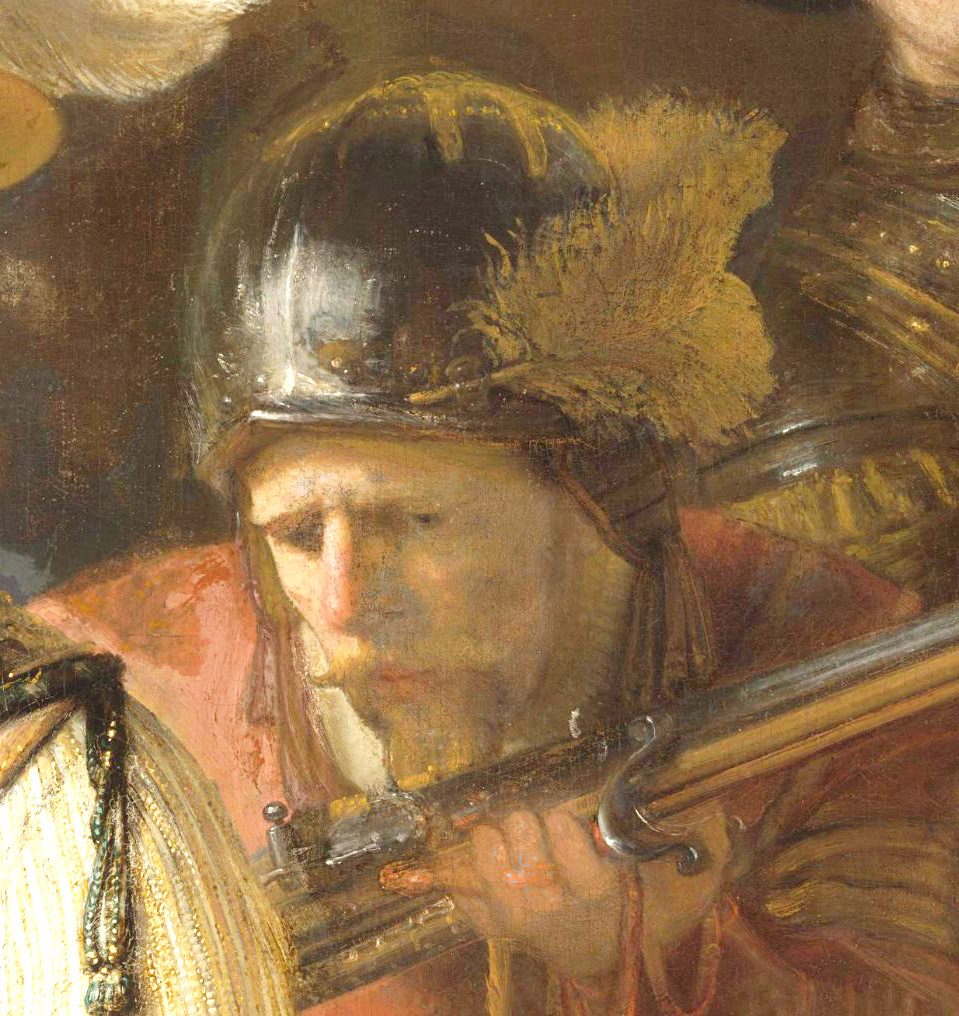
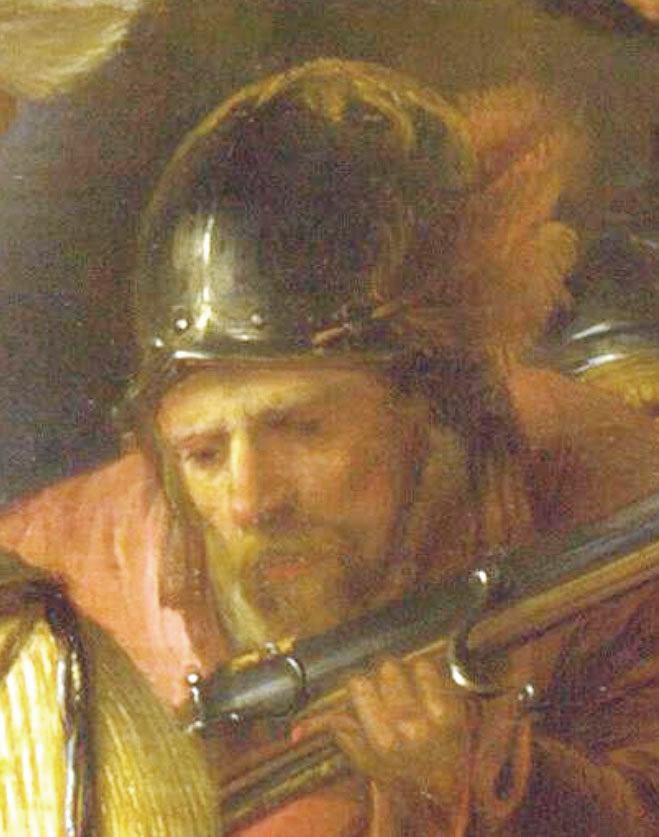
1st: Home; 2nd: by Rembrandt (1642); 3rd: by Lundens (1649);
Jan Claesz Leijdeckers stands out in The Night Watch not for his wealth or status, but precisely for the opposite. Unlike his fellow civic guards, he did not prosper in business. His father was a shoemaker, and Jan himself ran a modest shop, probably dealing in fabrics. He married in 1622. His financial situation, however, steadily deteriorated. When he died young in 1640, his debts were so large that even the sale of all his possessions could not cover them. His wife died only months later, leaving two children with no inheritance. One hopes that some of his fellow civic guards, men of means, offered help.
Despite his financial troubles, Leijdeckers managed to pay Rembrandt the substantial sum of one hundred guilders to be included in The Night Watch. Perhaps he sensed that his life would be short and saw this as a way to secure a form of immortality among Amsterdam’s elite.
Rembrandt began sketching the guards soon after receiving the commission in 1639, and Leijdeckers’ prominent placement and detailed expression suggest that the painter took care to give him his money’s worth. It may also have helped that Rembrandt’s favorite student, Gerbrand van den Eeckhout, was Leijdeckers’ nephew.
His early death also confirms that the civic guards did not pose as a group for Rembrandt. Fellow musketeer van der Heede07 joined only in 1641 and therefore never met Leijdeckers.
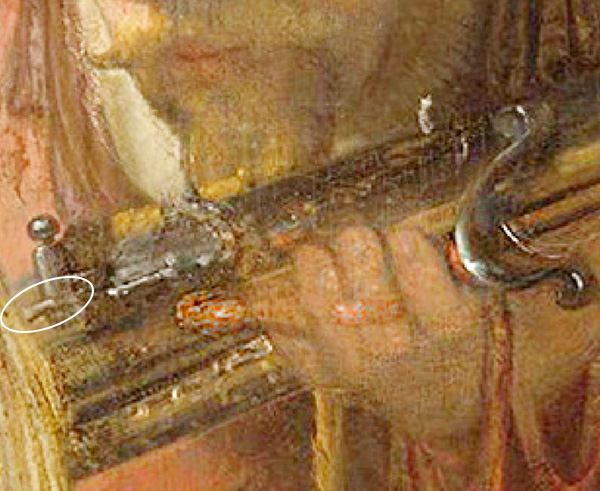
From the small section of the metal closing handle visible on the left side (here encircled in white) we can conclude that the flash pan of the musket is open. This shows that Leijdeckers has fired a shot and is blowing any remaining gunpowder residue from the flash pan.
In his left hand he holds two glowing wicks: slow-burning cords soaked in saltpeter that are used to ignite these old-fashioned muskets.
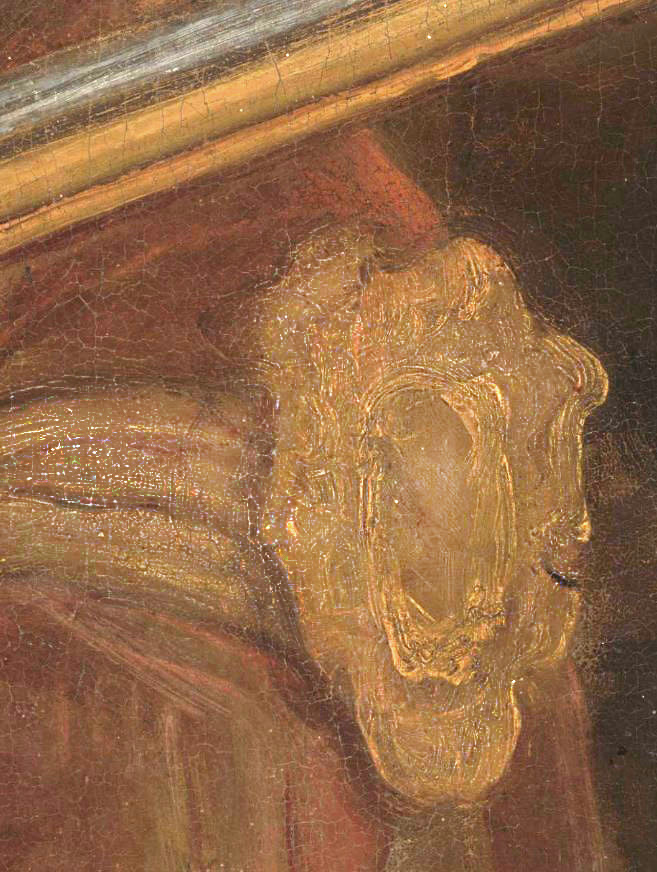
One of these will have come from the serpentine that touches the flash pan to fire the musket. A high-resolution image shows that Rembrandt may have repainted the serpentine and placed it closer to the flash pan. This change also required him to slighty reduce Ruytenburch's21 shoulder to include all of the musket's mechanism including the fraction of the closing handle.
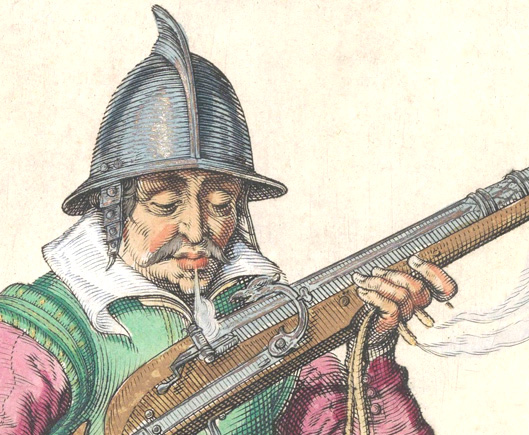
Rembrandt based Leijdeckers’ action on the Wapenhandelinghe engravings of 1607 by Jacob de Gheyn II, with whom he was well acquainted. He had painted a portrait of de Gheyn’s son in 1632.
Perhaps influenced by his own father’s musket accident, which left a hand disabled, Rembrandt uses several figures to demonstrate both correct and incorrect musket handling.
Willemsen06 does not visibly hold both wicks in one hand; van der Heede07 walks without keeping his musket safely angled, and the oak-leaf musketeer14 fires from an unstable stance.
Leijdeckers does not observe de Gheyn's requirement that the flash pan may only be cleaned when the wicks have been safely raised towards the top of the musket.
By keeping the wicks nearby, Leijdecker risks blowing gunpowder in the direction of his glowing wicks, with severe consequences.
These wick-operated muskets were all old-fashioned. When The Night Watch was commisioned, flintlock muskets were the standard.
Both van der Heede and Leijdeckers appear to have reddened noses from the heat of the wicks, a detail Lundens seems to have overlooked in his copy.
Leijdeckers wears a band with the marksman’s token on his left arm, embroidered with a crossbow. Despite his somewhat relaxed approach to loading his musket, he was a dangerous man in battle, and Rembrandt captures him at the precise moment when concentration and ritual meet the hazards of early firearms.