Jan Brugman (1614 - 1652), musketeer
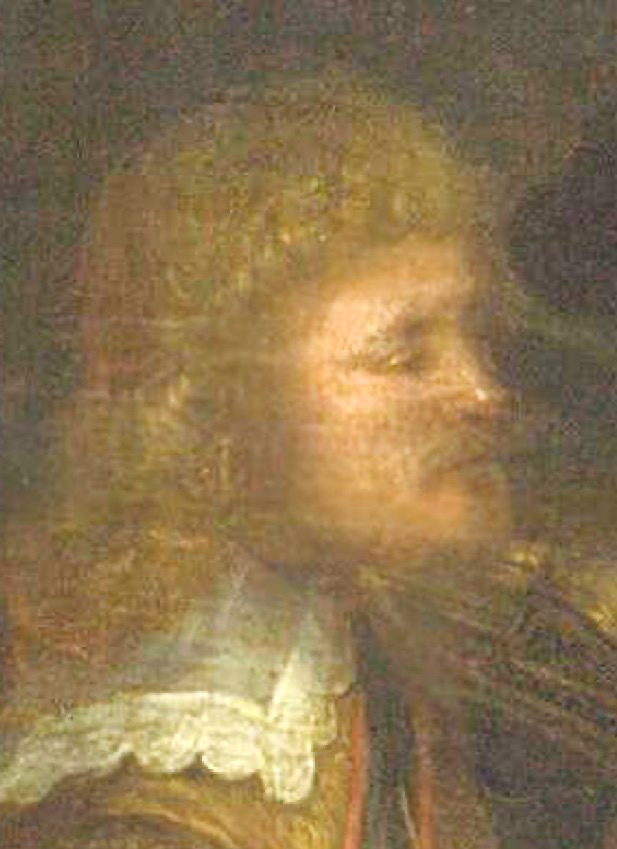
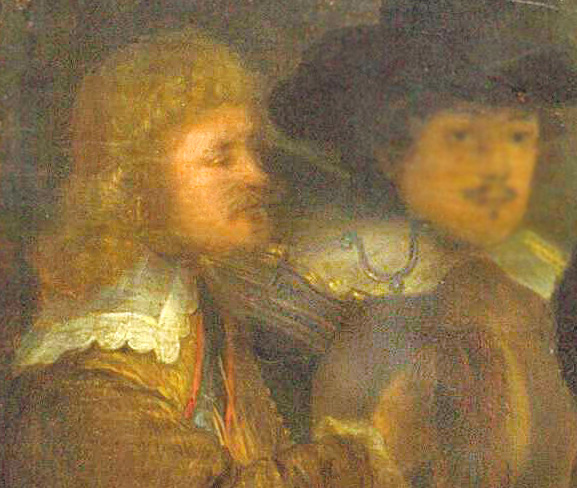
1st: Home; 2nd: by Lundens (1649); 3rd: Brugman shouldering musket.
Jan Brugman, also written as Brughman, came from a wealthy merchant family. His father had already served as lieutenant of the civic guards of district 2 in 1620. Together with Kemp27 and Bronchorst04, Brugman was among the richest cloth merchants Rembrandt portrayed in The Night Watch. In modern terms, each of them would be a multimillionaire.
Brugman married Cecilia Boelens in 1637, and in 1640 they purchased a country house in Beverwijk. His name appears on the cartouche35, confirming that he paid his hundred guilders to be included in the painting.
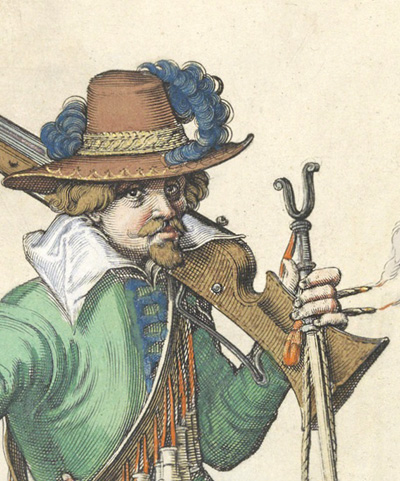
Young and blond, musketeer Brugman wears the standard costume of his time, without any of the pageantry seen on some of his fellow guards.
He has shouldered his musket in accordance with de Gheyn's weaponry manual, and holds his hat in his right hand, above which the forket protrudes. The forket was essential for firing the heavy musket with any accuracy. A few of the cords of his powder apostles are visible.
Given Brugman’s seated position and the placement of his hat, he may not be holding burning wicks in his left hand, or he may be shielding them from the toddler beside him.
Brugman served as provost of the bourgeoisie, a military judicial role responsible for enforcing regulations, handling financial matters, and taking disciplinary action. Rembrandt appropriately placed him near the drawbridge by the imaginary city gate, giving him a clear view of the advancing company.
When The Night Watch was trimmed in 1715 to fit between two doors in the new town hall, the cartouche was no longer visible and Brugman’s status and responsibilities were forgotten. The left side of the canvas was removed because the right side needed to retain a substantial portion of drummer Jorisz29. Cutting at Engelen's01 position was the most logical choice.
Brugman’s image survived thanks to the copy made by Gerrit Lundens around 1649. Lundens, still in training at the time, likely received the commission from Banninck Cocq16 himself. The request may have come in 1646, when Cocq was promoted to colonel, or in early November 1649, when Amsterdam mayor Gerbrand Pancras died and Cocq was asked to take his place, requiring him to relinquish his militia duties.
The National Gallery of Art in London maintains the completion year as 1649.
Brugman remains one of the quieter but wealthiest figures in The Night Watch, a disciplined musketeer whose position and responsibilities reflected the elite status of Amsterdam’s cloth merchants.