Jan Pietersen Bronchorst (1587 - 1666), shield bearer


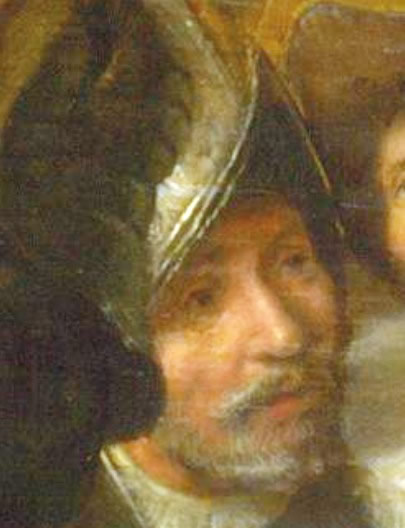
1st: Home; 2nd: by Rembrandt (1642); 3rd: by Lundens (1649).
In older documents he is also named Jan Metersen Bronckhorst. He is the oldest civic guard member in the painting.
He wears an antique Spanish helmet. This underlines the almost carnival-like way in which the civic guards enjoyed themselves while walking through the streets of Amsterdam.
Thanks to Jan Pietersen, we know that sixteen of the eighteen paying guardsmen had to pay an average of about one hundred guilders each to be visibly included in the painting.
After Rembrandt applied for insolvency in 1656, the court appointed a guardian for his son Titus, who was fifteen years old, to secure Titus's share of the inheritance from his mother Saskia Uylenburgh (1612 - 1642).
Bronchorst, together with Cruijsbergen15, testified that they had already paid Rembrandt their share for The Night Watch. Because of this, they had no responsibility to pay Rembrandt's creditors or any obligations to his son.
Banninck Cocq16 and Ruytenburch21 paid much more, probably around 500 guilders each, to be placed in the foreground. Bronchorst received only a meager background position for his money. Although he appears to hold the role of shield bearer, he has no shield and no sword. Both items are held in front of him by his neighbor Wormskerck.
Bronchorst could have afforded a better position. He had earned a considerable fortune from the cloth trade. Together with Kemp27 and Brugman31, he was one of the richest guardsmen, with an estimated net worth of about 200,000 guilders. This was a huge amount. In modern terms he would be a multimillionaire.
In fact, many members of this civic guard company were equivalent to modern multimillionaires. They could afford to walk around in antique militia clothing simply for enjoyment.
The difference between Rembrandt's original painting and the copy by Lundens is striking.