Girl in blue dress

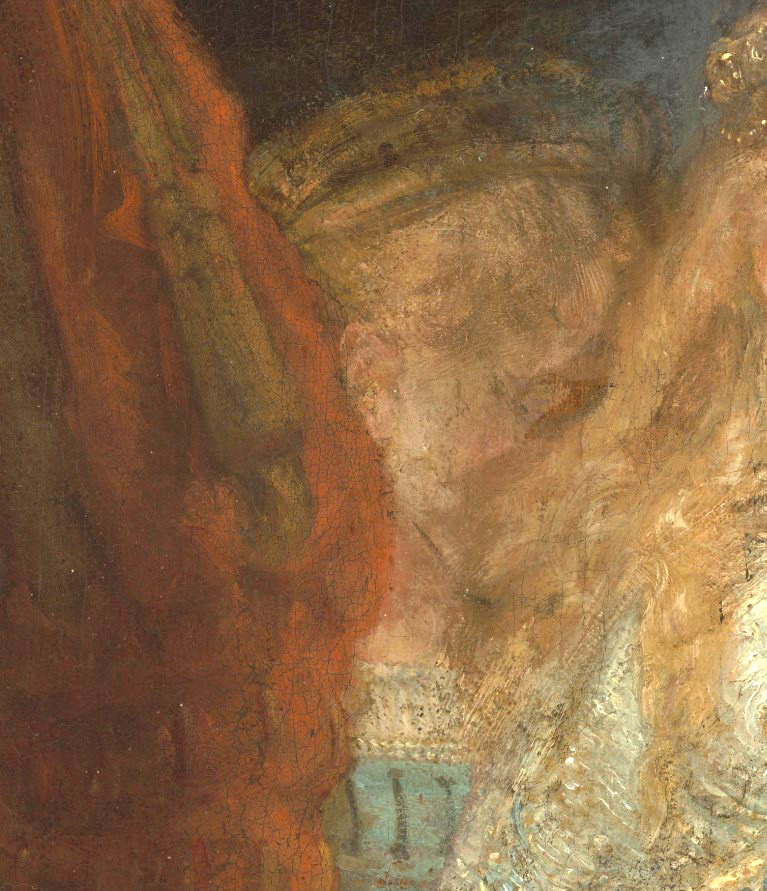
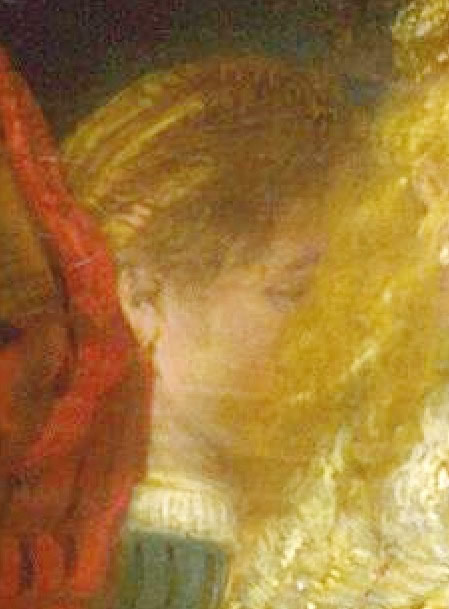
1st: Home; 2nd: by Rembrandt (1642); 3rd: by Lundens (1649).
The girl in the greenish blue dress seems to be running after her friend, or perhaps her sister, who wears the golden yellow dress. She runs partly behind her and one step higher, which is visible from the folds of her dress. This suggests she was several years younger, probably around seven or eight years old.
Only a few details of her face remain in the original painting. Time, aging, and less precise restorations have taken their toll. In the copy by Lundens, she has blonde hair and what may be a small earring. Her blue dress is far less rich than the yellow dress of the other girl, whom Rembrandt clearly used as a focal point.
The girls wear blue and yellow, the colors of the Kloveniers guild, the arquebusiers. The Dutch word klovenier comes from kolvenier, with kolf referring to the stock of the rifle.
Some documents suggest that both girls were daughters of the innkeeper of the Kloveniersdoelen. In 1642, however, the innkeeper Jacob Pietersz Nagtglas (1577 - 1654) was in his mid-sixties, while his children were in their twenties and early thirties. Rembrandt knew the Nagtglas family, so it is not unlikely that the two girls, dressed in the guild colors and carrying guild-related attributes, were Jacob's granddaughters.
A less romantic possibility is that Rembrandt simply invented them, using sketches of other models who posed in his studio.
Whether these girls in the painting are real or imaginary: children were known to enjoy watching the civic guards march by. These men looked fierce but were harmless, and children liked to test how quickly they could run across their ranks without being caught. Rembrandt must have observed this more than once, and it likely inspired him when he planned the design of The Night Watch.