Jan Ockersen (1599 - 1652), pikeman
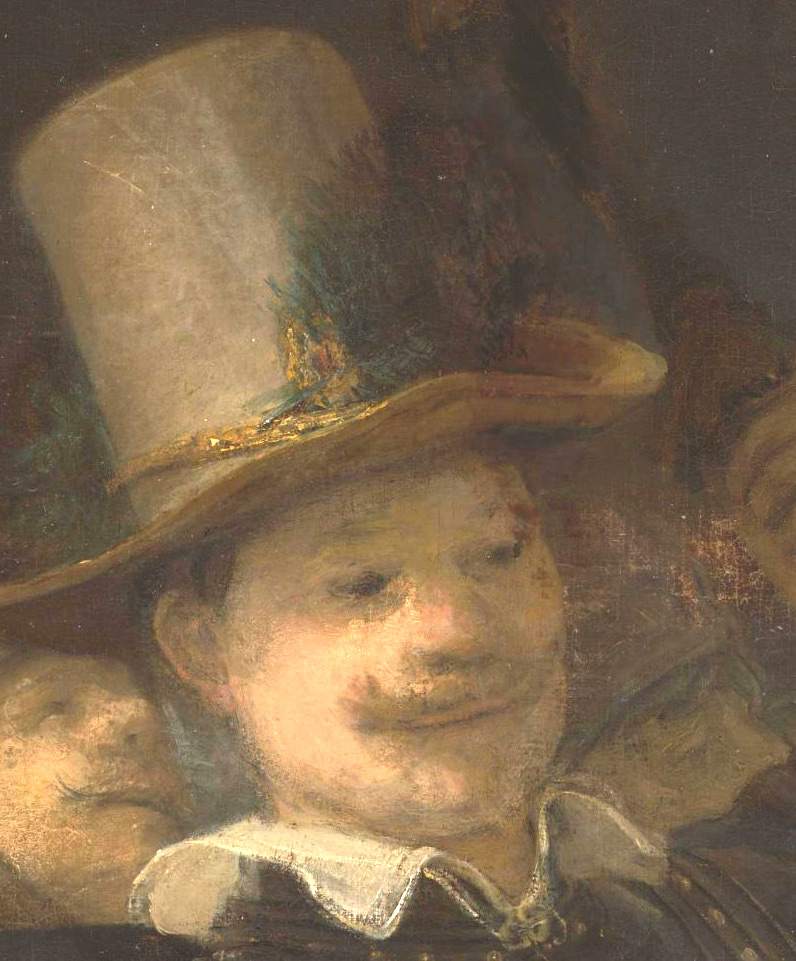
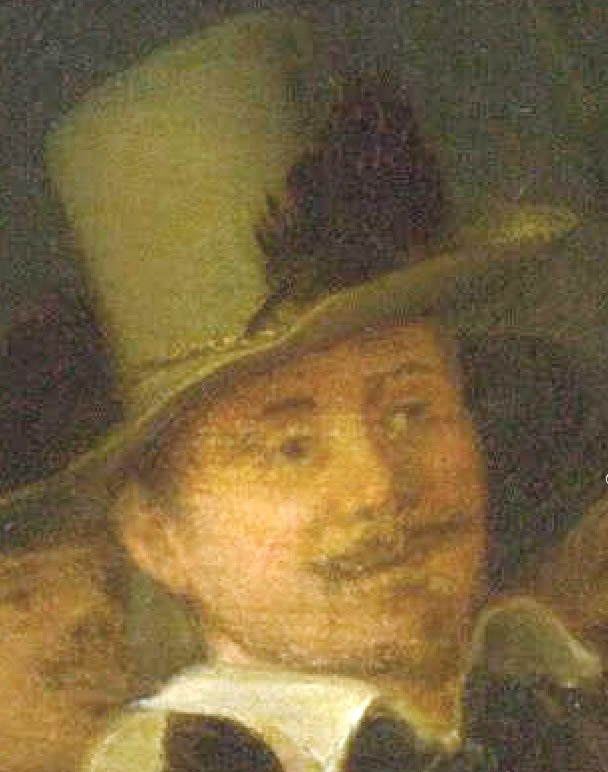
1st: Home; 2nd: by Rembrandt (1642); 3rd: by Lundens (1649).
Jan Ockersen is one of the four pikemen in The Night Watch, together with Schellingwou22, Bolhamer24, and Schoonhoven30. They all had sufficient wealth to pay Rembrandt for including them.
Rembrandt depicts the forty-year-old Ockersen with a surprisingly youthful expression, his eyes directed downward toward his pike. The weapon stands just behind Keijser20's massive two-handed sword and the plume of smoke rising from the musket of the oak-leaf musketeer14.
It is a busy corner of the painting, and Ockersen seems to be taking it all in with quiet concentration and a smile.
In Gerrit Lundens copy, made in 1649, Ockersen appears more mature. He has a visible goatee, a less curled moustache, and his gaze drifts into the distance rather than toward his pike. The differences are striking, but they may be explained by Lundens disadvantaged viewing position in the Kloveniersdoelen. Working from the floor of a poorly lit hall, looking up at a four-meter-high painting, he had little chance of capturing every facial nuance with Rembrandt's precision.
In both versions, the slight lift of Ockersens white lapels suggests that he has just stepped forward. It could also be a draught moving toward him, but Rembrandt rarely wasted a detail. A small forward motion fits the choreography of the scene.
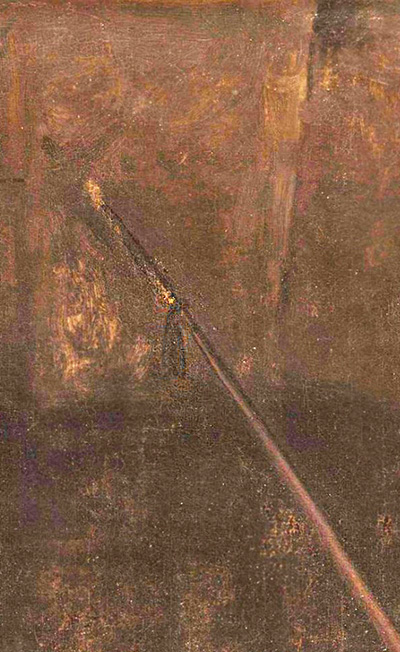
Only by considerably adjusting the image lighting can we identify the tip of Ockersen's long pike, with its black (or faded red) vane almost reaching the top of the arched gate from which the civic guards emerge. It is one of those details that Rembrandt painted confidently that, over time, disappeared into the shadows.
Ockersen came from an old patrician family from Zeeland. Like his father, Ocker Janszoon, he was a cloth merchant, a profession shared by many of the men in the painting. He also served as an inspector of weights and measures for the cloth guild, a position that required both trust and a good eye.
He lived at Nieuwendijk 181, in a house known as The Green Cloverleaf. In 1621 he married Wijntje Braber in Haarlem. A few years after The Night Watch was completed, he was promoted to lieutenant of the 21st district, a respectable step upward in the civic hierarchy.
Rembrandt historian Dudok van Heel uncovered a dramatic episode in the family history. The sister of Jan's grandmother, Weyn Ockers, became known during the iconoclastic unrest of 1566, when she threw a slipper through an altarpiece belonging to a corrupt priest. When the Spanish governor Alva arrived in Amsterdam in 1568, she was arrested, tortured, and sentenced for heresy. She was drowned (with her maid) in a barrel on Dam Square.
Jan Ockersen, standing quietly with his pike in The Night Watch, probably represents the more measured branch of the family.