Walich Schellingwou (1613 - 1653), pikeman
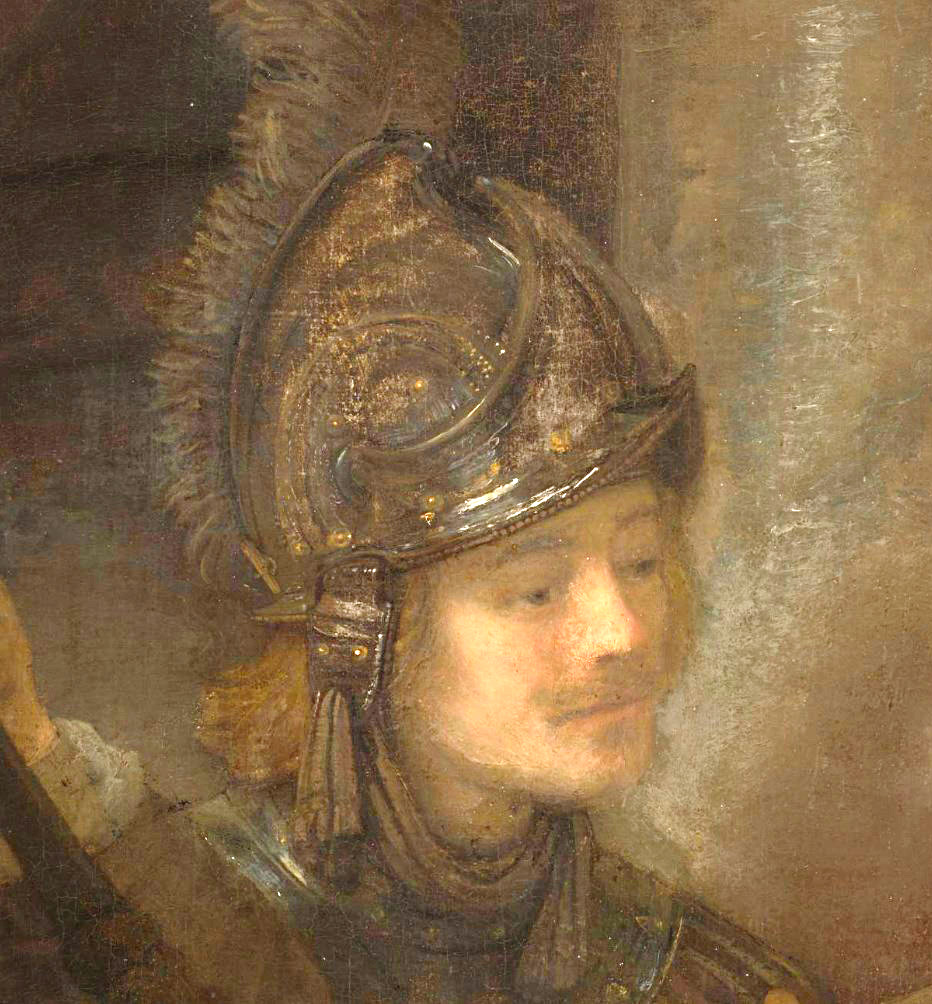
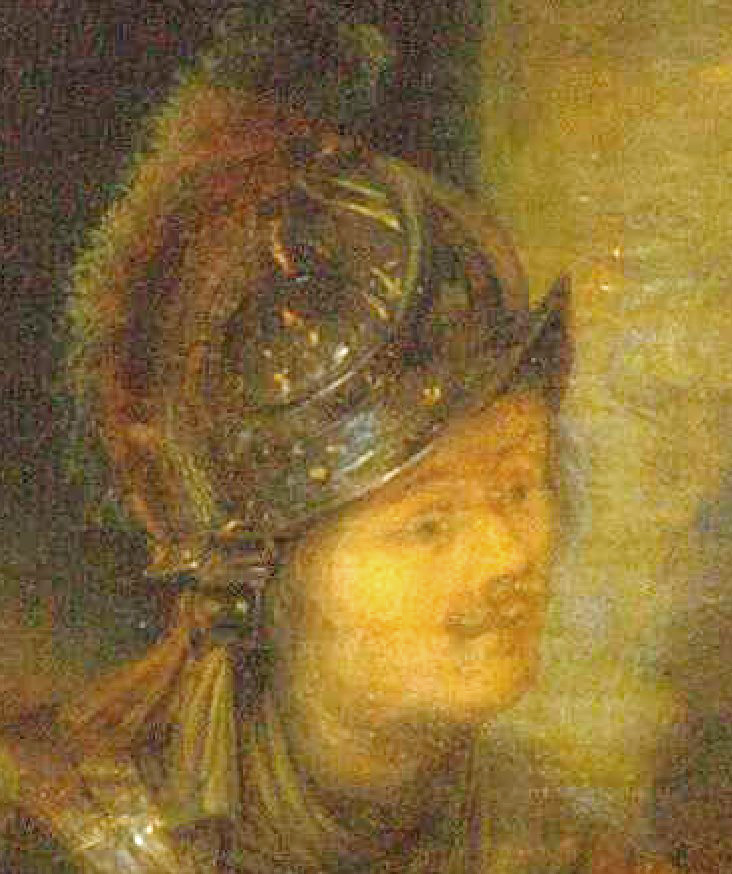
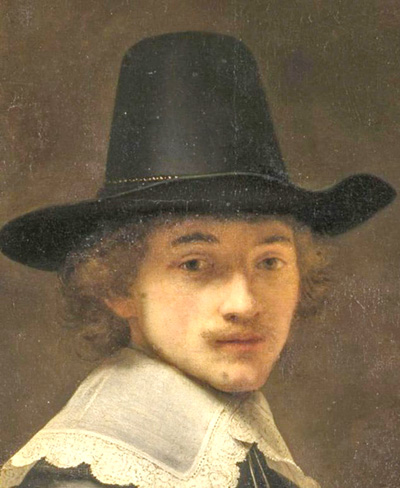
1st: Home; 2nd: by Rembrandt (1642); 3rd: by Lundens (1649); 4th: Schellingwou, Hermitage (1641).
The 19th century critic who described Walich van Schellingwou as a graceful youth with soft, almost feminine features, resembling Saint Raphael but one who has just received a summons bill, was not exaggerating. Among the rugged faces of The Night Watch, Schellingwou stands out as the most angelic of the pikemen. His family had been in the fabric trade for eighty years, but Walich chose a different path and became a wine merchant on the Nieuwendijk, a profession that ensured he was well known and well supplied.
In the 17th century, a healthy appetite for food and drink was practically a requirement for joining the civic guards, so Schellingwou fit the profile. In 1641 he married Margarieta Backers, and the couple commissioned two wedding portraits. His own portrait was mistakenly sold as a genuine Rembrandt to the Hermitage in 1772, though it is now believed to be by Ferdinand Bol. His wine trade flourished, and by 1645 he had moved to the prestigious Herengracht, a sign that business was going very well indeed.
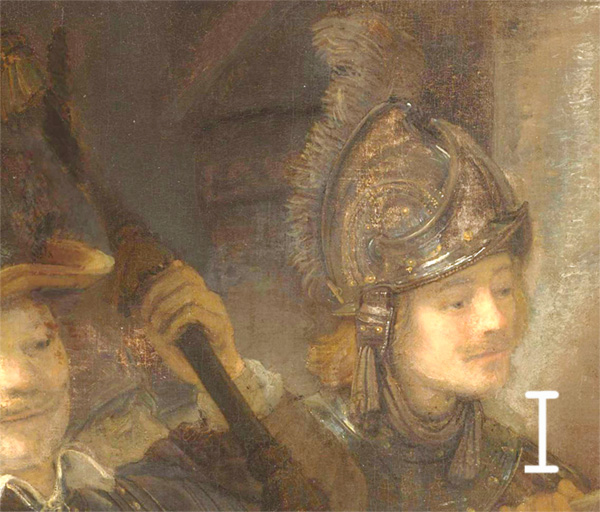
Judging by his posture in The Night Watch, Schellingwou has just lifted his lance from its resting position against the facade and is preparing to move it in the direction of the captain and lieutenant as they step forward. A somewhat risky maneuver.
Before he can do so, however, he must wait for Ockersen18 to shift his pike out of the way and for Keijser20 to stop blocking him with his enormous broadsword.
Rembrandt will have enjoyed arranging this painted version of mikado, the early 17th century stick game, with its precarious balance of weapons and limbs.
A safer approach for Schellingwou would be to follow Ockersen’s example and lift his pike upward. Both men’s positions correspond to the pike-handling guidelines published in 1607 by Rembrandt’s friend, the engraver Jacob de Gheyn. Ockersen’s stance is the safe handling position, while Schellingwou’s is closer to an active combat posture.
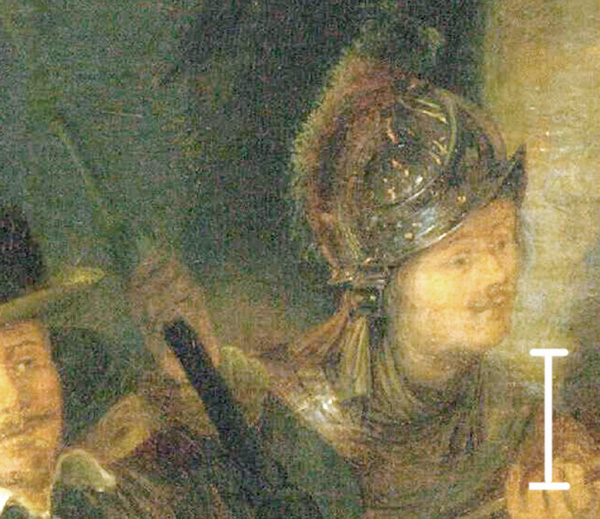
In Gerrit Lundens 1649 copy of The Night Watch, Schellingwou appears noticeably higher than in Rembrandt’s original.
In the original, his chin aligns with Ockersen’s nose; in the copy, it aligns with Ockersen’s eye.
Given Schellingwou’s high placement in the composition, the dim lighting of the Kloveniersdoelen, with that side of the painting partially in the shade of a large fireplace, Lundens likely misjudged the perspective. Also Schellingwou's face and helmet have a different perspective.
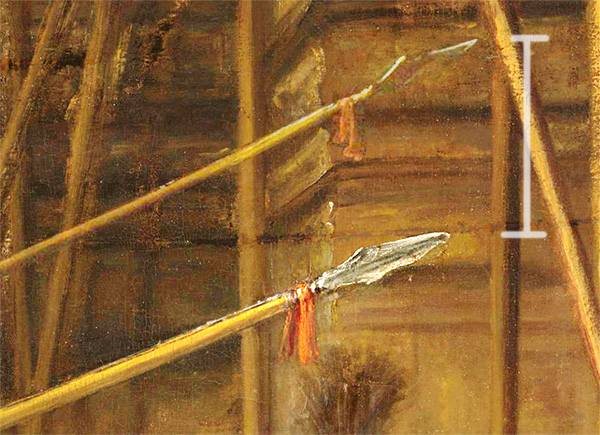
and by Rembrandt (bottom)
His version also alters the angle of Schellingwou’s pike, placing it significantly higher than Rembrandt’s original.
A comparison of the two shows the Lundens pike superimposed above Rembrandt’s version.
Because Lundens copied The Night Watch from left to right in six vertical sections, this adjustment in the rightmost section did not did not propagate further errors.
Schellingwou remains one of the most elegant figures in the painting, a youthful pikeman caught between movement and hesitation, his lance purposely poised by Rembrandt in a choreography of controlled chaos00.