Jan Corneliszn. Visscher (1610 - 1650), ensign
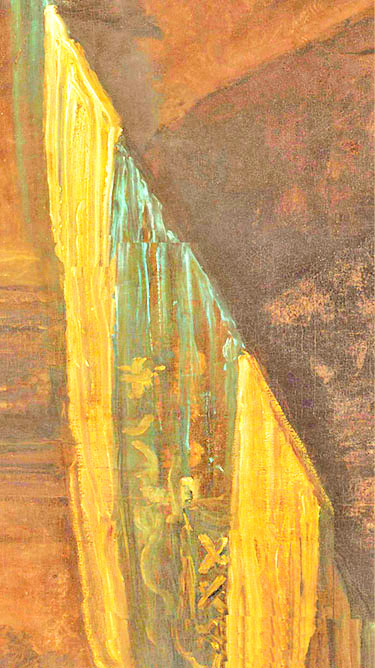
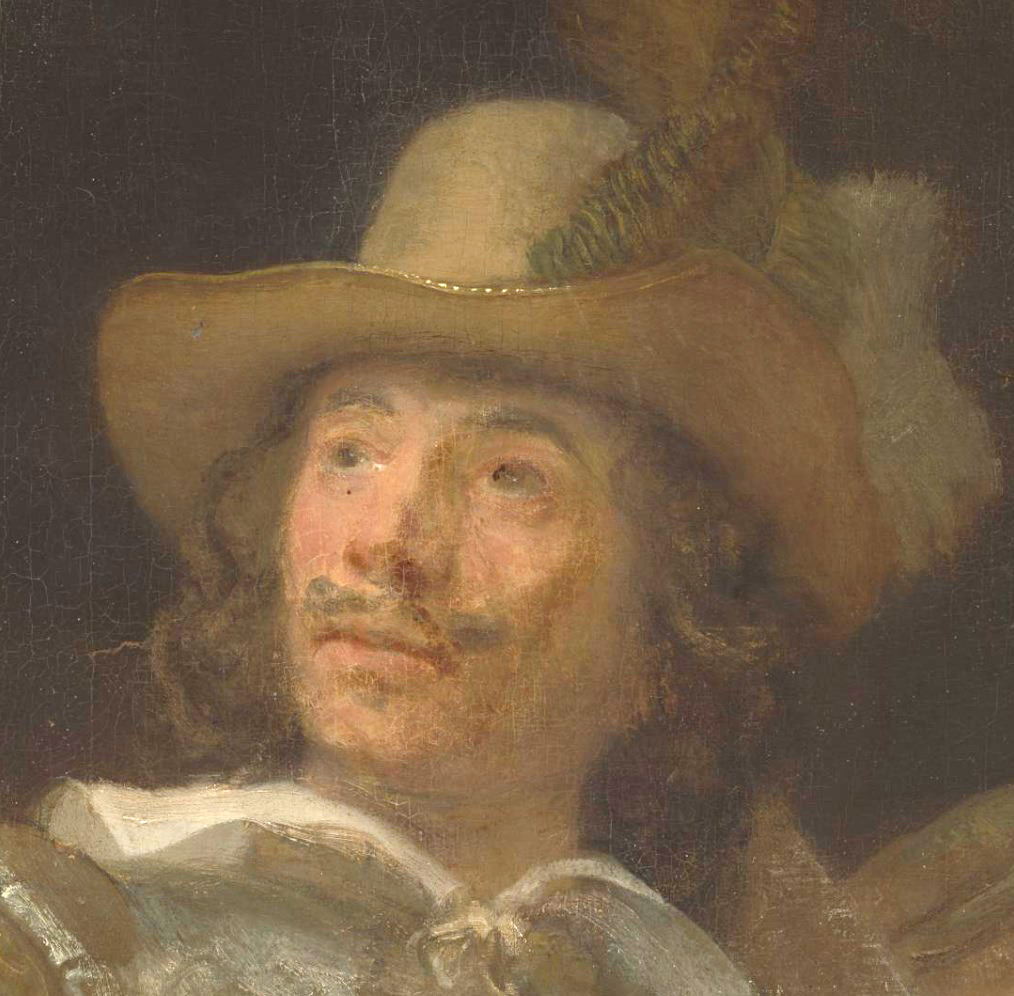
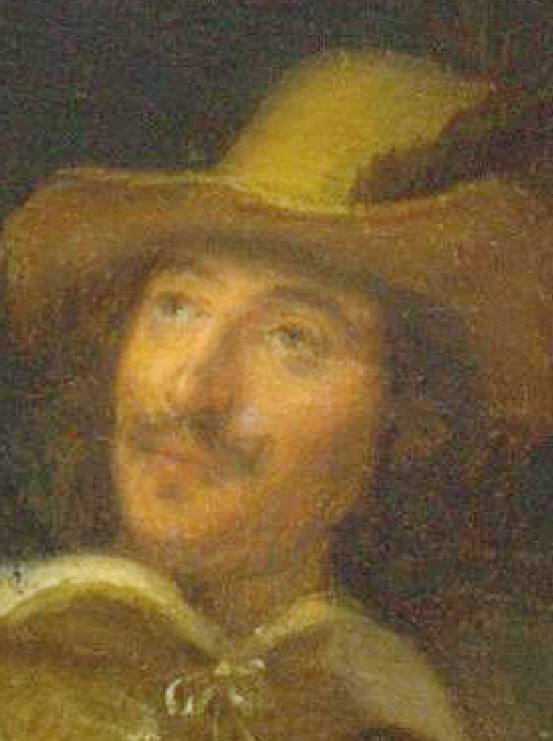
1st: Home; 2nd: by Rembrandt (1642); 3rd: by Lundens (1649).
Also known in older documents as Jan Visser Cornelissen. He does not wear a helmet but a graceful hat with plumes, a sash marking his role as standard-bearer, and of course the large banner with the city coat of arms and its three crosses.
One has to be a strong man to wave such a heavy banner. It takes strength and agility to get it moving and to keep it moving, especially when holding the pole at the very end, as he does here. His suit matches the colors of the Amsterdam banner so perfectly that one suspects he (was) dressed for the occasion.
The upward lift of his lapels and the wave of his overcoat show that he has just completed a quarter-turn toward Captain Banninck Cocq16 and is preparing to descend the steps to join the marching guards. By that time, the two running girls in front of him are hopefully gone.
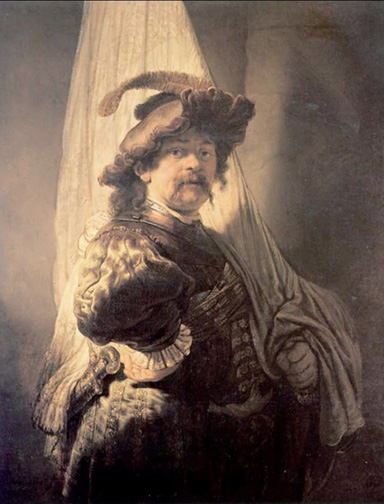
To improve balance, it helps to place the free hand on the hip. Rembrandt knew this well. He depicted himself in exactly this pose (few experts still debate this) as an ensign several years earlier, in his painting The Standard Bearer from 1636, acquired by the Dutch State in 2022 for 175 million euro. He now repeats the pose with Visscher.
The banner allows everyone to recognize the company. Because of this responsibility, the ensign cannot take an active role in battle. If the ensign falls, the battle is lost. He is therefore surrounded by four shield-bearers. In The Night Watch, these are Bronchorst04, Wormskerck05, Cruijsbergen15, and an anonymus fourth man17.
Some descriptions claim that the ensign, because of his vulnerable role, was better off remaining single.
Indeed, Visscher never married. However, his safety was essential to the company. At the start of an attack, he stood ahead of the soldiers, but before the fighting began, he withdrew to keep both the flag and himself intact. A practical arrangement.
Jan Corneliszoon Visscher was, like many fellow guardsmen, a wealthy trader specializing in the Baltic region. He lived on the corner of Molsteeg and Nieuwzijde Achterburgwal, a sensitive man with an extensive art collection.
In addition to his immortality in The Night Watch, he became known through Vondel's funerary poem from 1652 on his sudden death:
"So one sees Visscher who has waved the flag..."
A fitting summary for a man who spent his life making sure the flag did not fall.